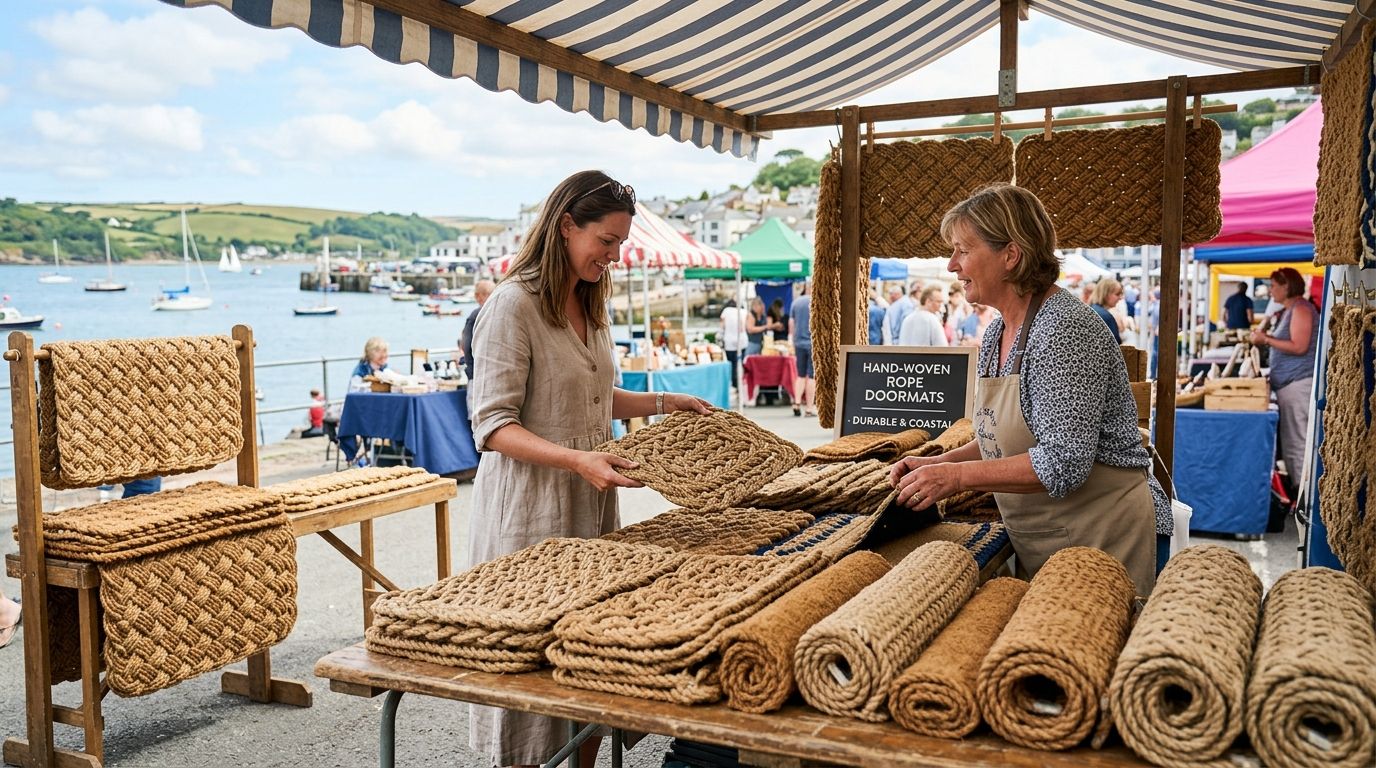
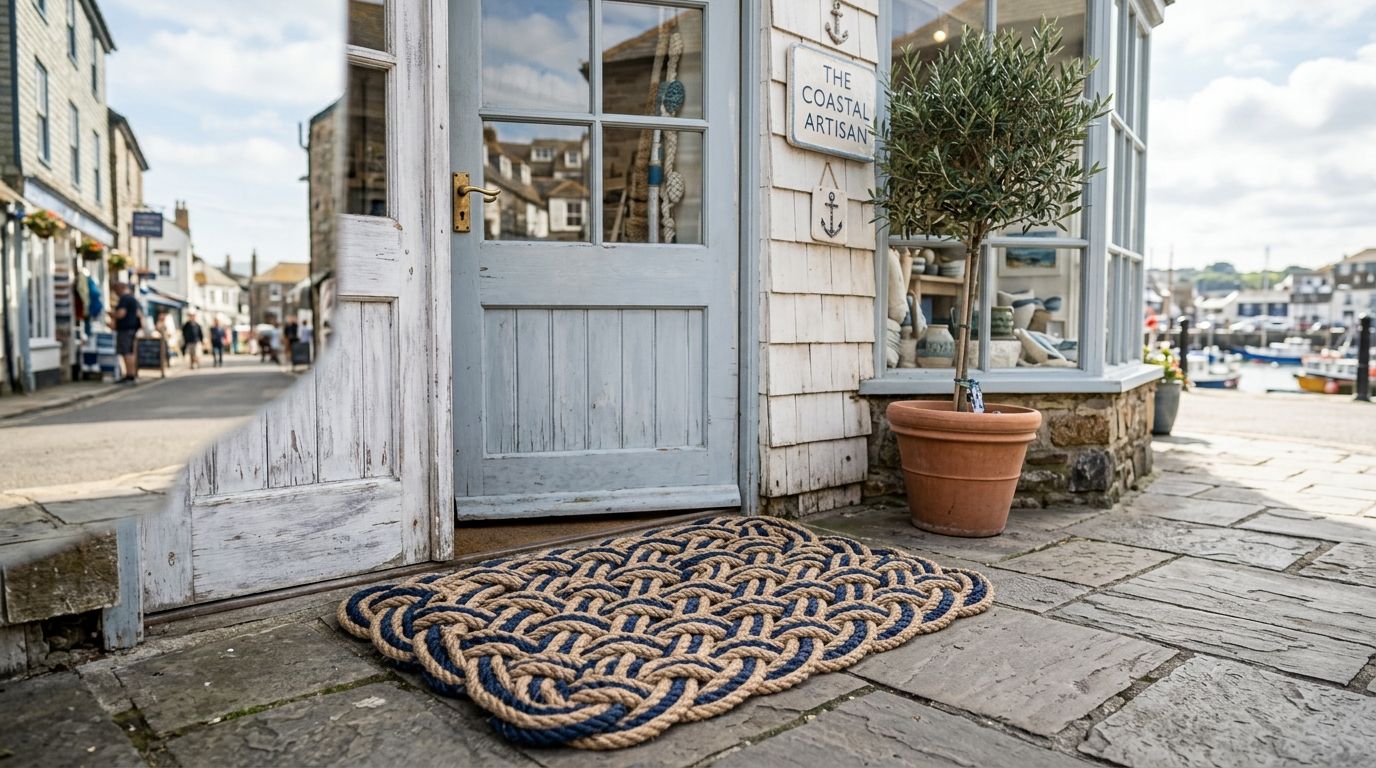
Rope doormats for farmers market stalls are handwoven lobster rope mats placed at the entry point of an outdoor vendor booth, built to catch sand, dirt, and moisture before customers step onto your table, scale, or cash box. A weekend market stall gets a different kind of wear than a front porch: it's set up and broken down every week, sits directly on grass, gravel, or asphalt, and takes gusts of wind under an open canopy with no walls to block it.
That combination — repeated handling, direct ground contact, and exposure to sun and rain with zero shelter — is what separates a stall mat from a home entryway mat. A mat that curls, slides, or holds onto grit between markets becomes a liability instead of a convenience.
A farmers market stall runs on turnover. You're greeting customers, handling cash, and restocking product while people track sand, dew, and dropped produce across the same three square feet of ground in front of your table. A doormat there isn't decorative — it's the difference between a clean stall floor at noon and a gritty mess by 10 a.m.
Coastal markets add wind and salt air to the mix. A mat that isn't rated for outdoor use fades, mildews, or stiffens after a few Saturdays near the water. Vendors who set up weekly need something that survives loading into a van, unrolling on pavement, and getting hosed off before the next market — not a mat designed to sit still on a covered porch for years.
A tight, dense weave looks tidy but holds onto sand and dirt like a filter, which means it needs shaking out after nearly every market. An open, wide-gap weave lets debris fall through instead of sitting on the surface. The heavy sand traffic weave guide breaks down which patterns shed grit fastest, and it's the first call to make before buying anything for a stall.
An open-sided canopy turns into a wind tunnel the second a gust comes through, and a light, unsecured mat becomes a tripping hazard. Rope doormats have enough natural weight to resist light wind, but stall vendors in exposed lots need a backup plan. The anchoring guide for high wind areas covers weighting and securing methods built for exactly this situation.
A mat that can't be rinsed and dried fast enough turns into a mildew problem by the third weekend. Lobster rope mats are built to be shaken out and hosed off, which matters when you've got twenty minutes between load-out and getting home. The cleaning guide for lobster rope doormats lays out the shake, rinse, and dry sequence that keeps a mat usable market after market.
Many farmers markets slow down or pause for a season, and a mat left crumpled in a storage bin picks up mildew fast. Rope holds up better with airflow around it during downtime.
A stall mat that needs replacing every season costs more over three years than one built to last. Ropemats Florida backs its lobster rope doormats with a 10-year replacement guarantee, which matters more to a vendor using a mat 40-plus market days a year than to someone using one four times a month at home.
Get a stall-ready rope doormat
Handwoven lobster rope mats built for weekly setup and coastal weather.
| Option | Best for | Key limitation |
|---|---|---|
| Bare pallet or tarp | Vendors testing a new market with no budget yet | No sand or moisture control, slick when wet |
| Standard plastic drainage mat | Indoor or covered markets only | Cracks and fades fast in direct sun |
| Coir or fiber doormat | Occasional weekend vendors | Traps sand, slow to dry, mildews near coastal air |
| Lobster rope doormat (Ropemats Florida) | Weekly coastal vendors needing durability | Heavier to transport than thin synthetic mats |
Verdict: a lobster rope doormat is the strongest choice for any vendor running a stall more than twice a month near coastal weather — the open weave sheds sand and the rope construction survives repeated wet-dry cycles that break down synthetic mats within a season.
What’s the best rope doormat weave for farmers market stalls?
An open basket or herringbone weave works best because it lets sand and grit fall through instead of packing onto the surface. Tighter weaves look cleaner in photos but clog fast under weekly foot traffic in 2026 market conditions.
Do rope doormats hold up to weekly setup and breakdown?
Lobster rope doormats are built for repeated handling and rinse cycles, which is closer to a marina or dock use case than a static porch mat. Rolling rather than folding between uses extends the mat’s life significantly.
How do I keep a stall mat from sliding in wind?
Weight the corners with sandbags, bricks, or display crates positioned to hold the mat flat. Mats under 1.5 pounds per square foot need extra anchoring in fully open, uncovered lots.
How often should I clean a rope doormat used at a market stall?
Shake it out after every market and rinse it at home whenever it’s picked up visible dirt or sand. A quick rinse-and-air-dry cycle after a sandy or rainy market prevents mildew from setting in.
Is a lobster rope doormat better than a plastic drainage mat for outdoor stalls?
Yes, for coastal or sun-exposed markets — plastic drainage mats crack and fade with direct UV exposure faster than rope construction handles it. Rope also drains and dries faster after a rinse, which matters between weekly markets.
What color rope doormat hides dirt best at a vendor stall?
Darker rope tones like navy, charcoal, or deep brown hide ground-in dirt and grass stains better than light tan or white weaves. Lighter colors show wear faster under weekly stall use.
Can one rope doormat last a full farmers market season?
Yes, with proper rinsing and dry storage between markets, a well-built lobster rope doormat can run a full weekly season and into the next. Ropemats Florida backs its mats with a 10-year replacement guarantee for exactly this kind of repeated use.
Do I need a different mat for covered versus open-air stalls?
Open-air stalls need heavier anchoring and full weatherproofing since there’s no canopy to block wind or rain. Covered stalls can use a lighter setup but still benefit from a sand-shedding weave if the ground is grass or gravel.
Most vendors buy a stall mat sized for a doorway, not a booth entry, and end up with something too narrow to catch the actual foot traffic pattern in front of a 10-foot table. Measure the real entry width of your setup before ordering — a mat that's a foot too narrow does almost nothing.

Doormats designed to look better, last longer, and clean easier.

Handmade lobster rope doormats crafted for outdoor durability, easy care, and a warm first impression. Designed for porches, patios, entryways, decks, boats, and RVs across the USA
Copyright © 2026 All Rights Reserved.