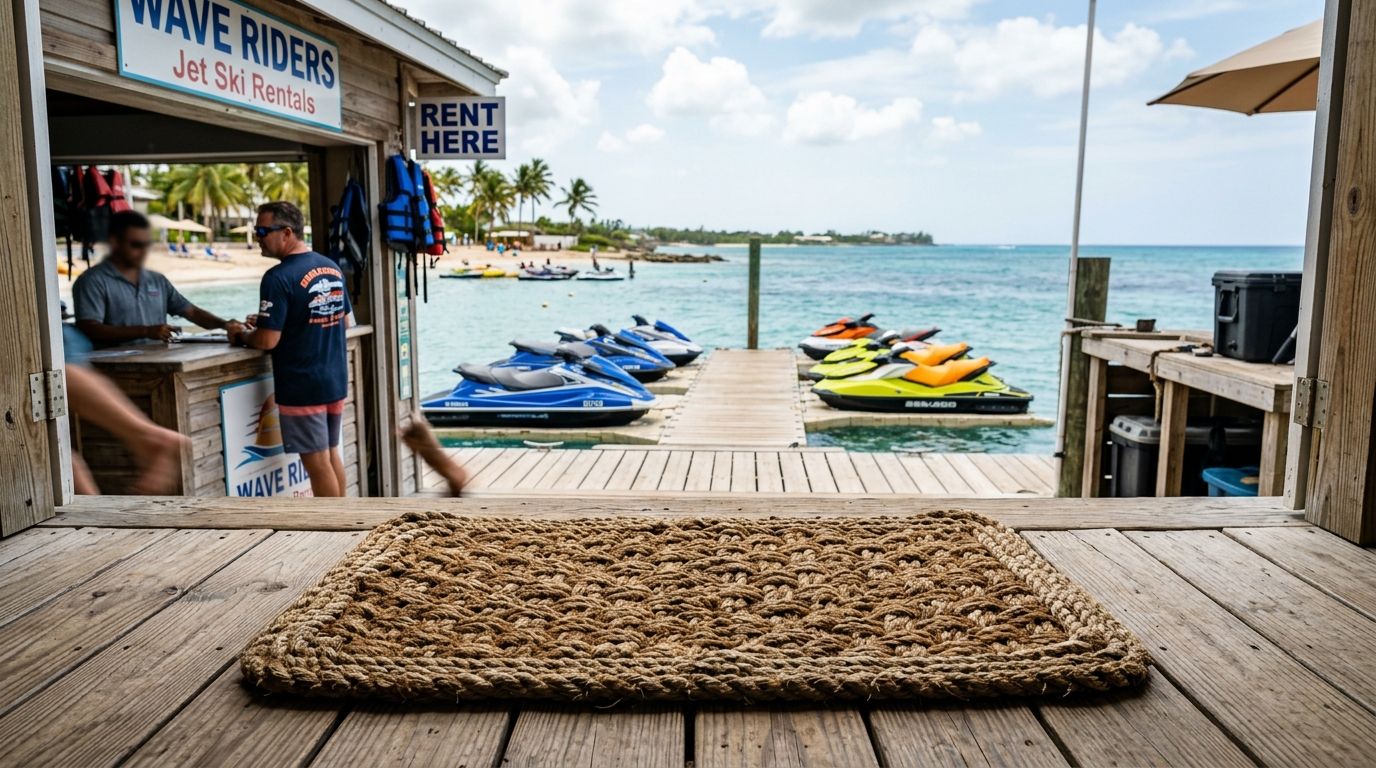
Jet ski rental shop doormats have to survive nonstop sand, salt spray, and bare wet feet coming off the dock every 20 minutes without turning into a slip hazard at the counter. A backyard porch mat gets shaken out once a week; a rental shop entry gets hit by 40-100 pairs of wet feet a day during peak season, so the weave, the anchor, and the cleaning routine all need to be built for commercial traffic, not residential foot count.
A jet ski rental counter sits at the intersection of sand, salt, and constant foot traffic, which is a harder environment than almost any residential entryway. Renters walk off a wet dock, cross a mat, and step into a retail space where slip-and-fall liability is a real operating cost, not a hypothetical.
Most indoor-outdoor carpet mats mat down within a season under that kind of load, and rubber-backed mats trap sand and salt against the flooring underneath instead of releasing it. A rope doormat built for boat rental companies handles that differently: the open lay of the rope lets sand fall through instead of packing into fibers, and the material sheds water instead of holding it against a threshold.
Ropemats Florida ships handmade lobster rope doormats for exactly this kind of commercial coastal use, and the 10-year replacement guarantee is built around the assumption that a rental shop entrance will wear out a mat faster than a homeowner's porch ever will.
Before picking a weave or size, count what actually crosses the doorway on a busy Saturday.
The weave decides whether sand ends up on your floor or falls through the mat.
Read the full breakdown on how to pick a rope doormat weave for heavy sand traffic before you settle on one style for every location.
A mat that's too narrow forces single-file crossing and defeats the purpose during a rush of renters.
Salt air and direct sun break down most doormat materials faster than rain ever does.
Ropemats Florida's lobster rope construction is built to take repeated salt exposure without the fiber breaking down the way cotton or jute blends do within a single season.
A cleaning schedule only works if it takes under two minutes and doesn't require pulling the mat indoors.
Dock-adjacent entries catch gusts and boat wake spray that can shift a loose mat into a trip hazard.
A rental shop's entry doubles as a first impression, and mat color plays into that whether you plan for it or not.
| Option | Best for | Key limitation |
|---|---|---|
| Open diamond weave rope mat | High sand-traffic entries near docks | Slightly less cushioned underfoot than tighter weaves |
| Rubber-backed indoor-outdoor mat | Low-traffic back offices | Traps sand and salt against flooring, breaks down fast in sun |
| Coir fiber mat | Low-budget temporary setups | Sheds fiber and rots quickly under repeated salt exposure |
| Handmade lobster rope mat (Ropemats Florida) | Full commercial dock and storefront entries | Requires periodic rinsing to stay at its best |
The verdict: an open-weave lobster rope mat outperforms rubber-backed and coir options at a jet ski rental shop entrance because it releases sand instead of trapping it, and it holds up to daily salt exposure across a full 2026 rental season.
Outfit your rental shop entrance
Browse handmade rope doormats built for salt, sand, and daily foot traffic.
What’s the best doormat for a jet ski rental shop entrance?
An open-weave lobster rope doormat is the best choice for a jet ski rental shop entrance because it sheds sand and salt water instead of trapping them against the floor. Rubber-backed and coir mats break down faster under daily commercial foot traffic.
How often should a rental shop clean its entry doormat?
Shake out sand at the start and end of each shift, and hose the mat down weekly during peak rental season. Salt buildup between rinses is what shortens a mat’s lifespan fastest.
Do rope doormats hold up better than rubber mats at marinas?
Yes, rope doormats generally outlast rubber-backed mats in marina and dock settings because the open weave lets sand and moisture pass through instead of sealing against the flooring underneath. Rubber backing also degrades faster under direct sun.
What size doormat does a rental shop entrance need?
Measure the full clear width of the doorway and add 6-12 inches of overlap on each side for high-traffic entries. A depth of 36 inches or more keeps both feet landing on rope before the floor.
Can a rope doormat handle daily salt water exposure?
A handmade lobster rope doormat is built to handle repeated salt water exposure without breaking down the way cotton or jute blends do. Regular rinsing extends that further across a full season.
Is a custom-size rope doormat worth it for a wide storefront entry?
Yes, for doorways wider than a standard mat run, a custom size or two mats placed end-to-end keeps sand containment even across the full entry. A too-narrow mat forces single-file traffic and pushes sand around the edges.
Most rental shop owners size the mat to the door frame and stop there, but the real failure point is usually six inches past either edge, where renters step off the mat to avoid a line and track sand straight past it. Oversizing the width by even 12 inches beyond what looks necessary solves more sand complaints than switching weaves ever does.

Doormats designed to look better, last longer, and clean easier.


Handmade lobster rope doormats crafted for outdoor durability, easy care, and a warm first impression. Designed for porches, patios, entryways, decks, boats, and RVs across the USA
Copyright © 2026 All Rights Reserved.