
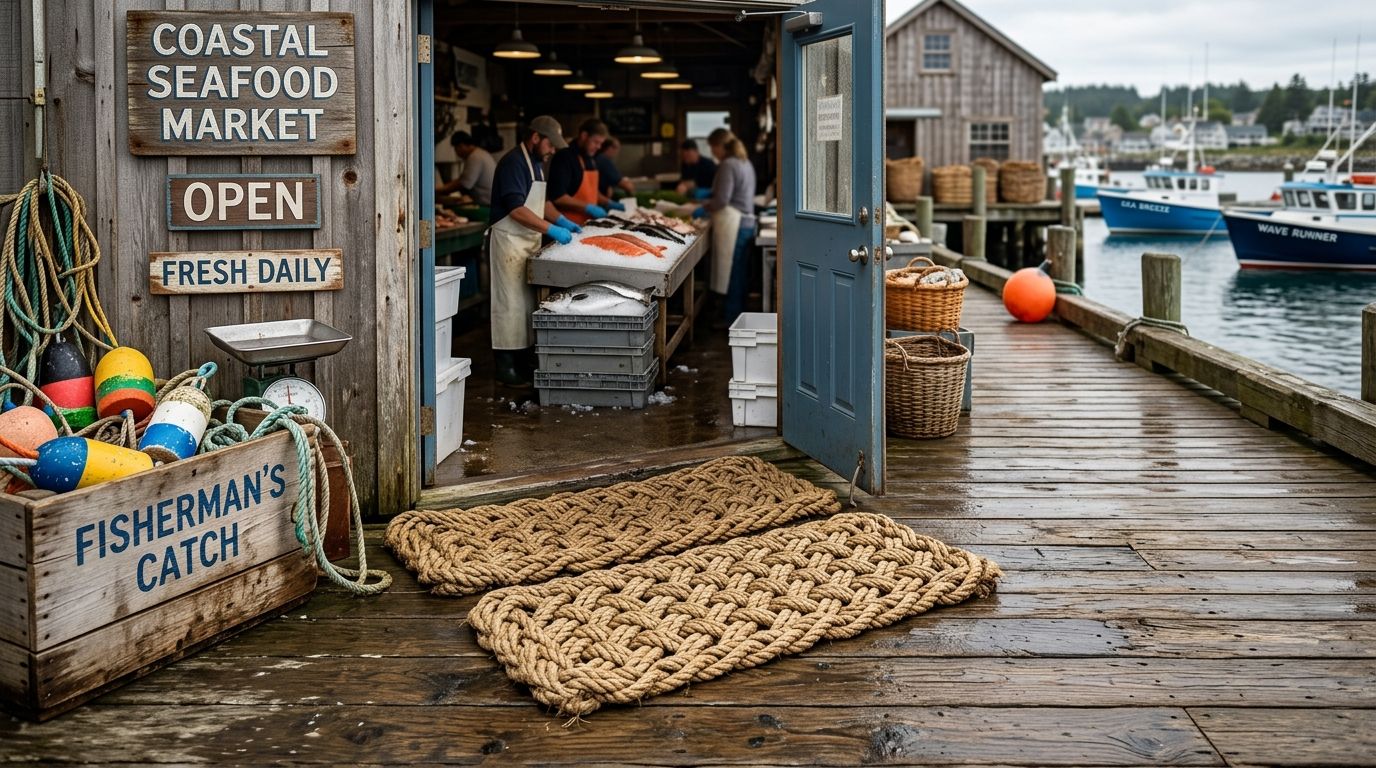
Coastal fish markets take a beating at the entrance: wet boots, fish scales, ice melt, and salt spray track in every single day. The best rope doormats for fish markets are heavy-duty lobster rope weaves that drain fast, rinse clean, and hold up to constant foot traffic — not decorative coir mats that mat down and trap odor within a season.
A fish market floor sees more moisture and organic debris in one day than most beach house porches see in a month. A doormat that can't shed water or resist salt breaks down fast, curls at the edges, and starts holding odor instead of stopping it at the door. Rope construction — specifically thick lobster rope — handles this differently than woven coir or rubber-backed mats because the fiber sheds water between strands instead of soaking it up.
The right weave for a heavy foot traffic marina is a good starting reference point: fish markets share the same abuse profile — constant wet shoes, sand and grit tracked from docks, and daily hose-downs. Ropemats Florida builds its rope doormats around exactly that kind of use, which is why the same weave logic applies whether the entry sits at a marina bait shop or a working fish market counter.
| Weave type | Best for | Standout feature | Key limitation |
|---|---|---|---|
| Solid braid lobster rope | Heavy daily foot traffic | Dense weave resists crushing under boots and carts | Slower to dry than open weaves |
| Open sand-through weave | Wet floors and drainage | Gaps let water and grit pass through instead of pooling | Less cushioning underfoot |
| Double-thick natural fiber | Narrow back dock entries | Compact footprint with added rope density | Limited color selection in narrower sizes |
| Oversized custom weave | Wide loading dock or cooler entries | Built to size for non-standard openings | Longer lead time to handweave |
| Dark-toned standard weave | Daily practical use, budget-minded owners | Dark rope tones mask fish-market staining | Less visual pop for a retail storefront look |
This is the standard build most fish markets should start with. The rope is packed tight, strand to strand, so it holds its shape under boots, hand trucks, and ice buckets moving through the door dozens of times a day.
Solid braid weave pros:
Solid braid weave cons:
Best for: markets with steady counter traffic all day, every day. Verdict: Buy.
When the floor near the entrance stays damp from ice melt or hose-down runoff, a tighter weave just holds water on the surface. An open, sand-through weave built for heavy sand traffic does the opposite job: it lets moisture and grit fall through instead of sitting on top of the rope.
Sand-through weave pros:
Sand-through weave cons:
Best for: entries with standing water, ice runoff, or constant drip. Verdict: Buy.
Most fish markets have a narrower service or delivery door in addition to the main entrance. A standard-width mat either doesn't fit or leaves gaps where debris slips past on either side.
Double-thick weave pros:
Double-thick weave cons:
Best for: staff and delivery doors, not the main customer entrance. Verdict: Buy for back-of-house use.
Walk-in coolers, loading docks, and double-wide market entrances need a footprint most stock doormat sizes don't cover. Getting the right size for a wide entryway matters more here than color or pattern — a mat that's too narrow just gets stepped around.
Oversized weave pros:
Oversized weave cons:
Best for: loading docks, walk-in cooler entries, and double-door market fronts. Verdict: Buy for wide entries.
Not every market needs a custom order. For a straightforward daily-use mat, a dark-toned standard weave is the practical, low-maintenance pick — it hides staining between cleanings better than lighter colors do.
Dark-toned weave pros:
Dark-toned weave cons:
Best for: owners who want a no-fuss, daily workhorse mat. Verdict: Buy.
“A fish market entry needs a mat that drains fast and rinses clean, not one that just looks coastal.”
Each weave above was matched to a specific fish market pain point — traffic volume, drainage, entry width, or maintenance load — rather than ranked as one mat beating another across the board. That's the honest way to compare rope doormats: a solid braid weave and an open sand-through weave aren't competing for the same job, they're solving different problems at the same market.
Get a mat built for your entryway
Handwoven rope doormats backed by a 10-year replacement guarantee.
For most fish markets in 2026, the solid braid lobster rope weave is the default pick — it handles daily boot traffic and hand truck wear better than lighter constructions. If the entry floods or drips constantly, switch to the open sand-through weave instead. Wide loading docks and walk-in coolers call for a custom oversized weave, and narrow back doors do better with the double-thick option. Budget-minded owners who just need a daily workhorse should stick with the dark-toned standard weave and skip the customization.
Whatever the pick, protecting the rope from salt water extends its working life significantly in a market environment where salt and brine are part of the daily routine.
What’s the best rope doormat for a coastal fish market?
A solid braid lobster rope weave is the best all-around choice for fish markets because it resists crushing under daily boot and cart traffic. Markets with standing water or ice runoff do better with an open sand-through weave instead.
Do rope doormats hold up to fish market odor and staining?
Rope doormats resist odor buildup better than absorbent coir mats because they can be hosed down and shaken out rather than soaked. Dark-toned weaves also mask staining between cleanings.
How often should a fish market rinse its rope doormat?
Daily rinsing is standard for a working fish market entry given the volume of ice melt, brine, and fish debris tracked in. A quick hose-down and shake-out keeps the weave from holding grime.
Can a rope doormat be custom sized for a wide loading dock?
Yes, oversized custom weaves can be built to match a wide loading dock or double-door entrance. Standard mat sizes often leave gaps at these wider openings.
Is a rope doormat better than a rubber mat for a fish market?
Rope doormats drain and dry faster than solid rubber mats, which tend to trap moisture and odor underneath. Rope construction also resists cracking from constant wet-dry cycles better over multiple seasons.
Does salt water damage a lobster rope doormat?
Untreated exposure to salt water can shorten a rope doormat’s lifespan if it isn’t rinsed regularly. Protecting the rope with routine rinsing and proper drying keeps salt residue from breaking down the fibers.
What size rope doormat fits a standard fish market entrance?
Most standard market entrances fit a standard-width rope doormat, but double doors or loading docks usually need a custom oversized weave. Measuring the actual doorway before ordering avoids gaps at the edges.
The detail most fish market owners miss: it's the edges, not the center, that fail first on a heavy-traffic rope doormat. Constant cart wheels and hand truck edges wear the perimeter of a mat long before the middle shows any damage, which is exactly why a tight, handwoven edge construction matters more in a commercial entry than in a residential porch setting.

Doormats designed to look better, last longer, and clean easier.

Handmade lobster rope doormats crafted for outdoor durability, easy care, and a warm first impression. Designed for porches, patios, entryways, decks, boats, and RVs across the USA
Copyright © 2026 All Rights Reserved.